

A Practitioner's Guide to Integrated Demand Planning
Most demand planning debates focus on the forecast itself — the model choice, the accuracy metric, the statistical method. But a forecast is just one node in a larger circular flow. Obsessing over it in isolation is like tuning an engine while ignoring the rest of the drivetrain.
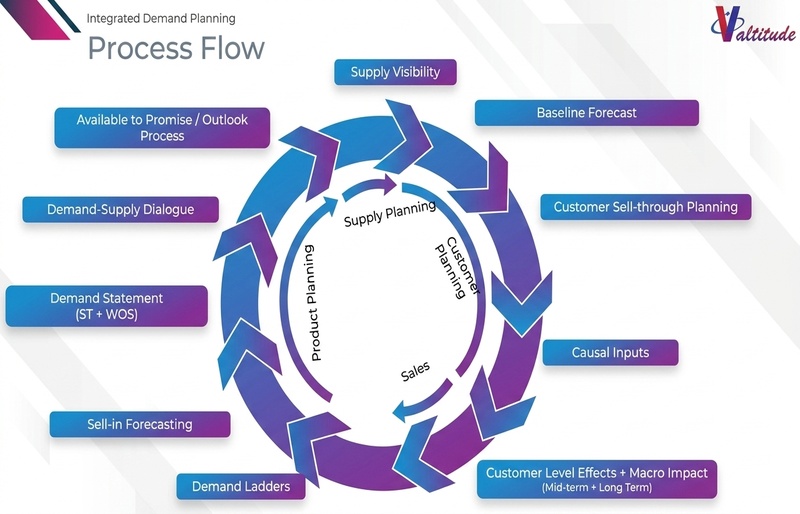
At Valtitude, we implement Integrated Demand Planning as a connected, cross-functional process — one where insights and data enrich the final number at every stage. Here is how that flow is structured.
1. Baseline Forecast
The statistical model is the starting point, not the answer. It establishes a quantitative anchor before any human judgment or market intelligence is layered on top.
2. Customer Sell-Through Planning
What is moving off the retail shelf matters more than what is being shipped in. Sell-through data grounds the plan in real consumer behavior, not just shipment history.
3. Causal Inputs
Promotions, pricing changes, and distribution expansions explain the why behind the numbers. The more these are modelled objectively rather than estimated qualitatively, the more defensible the forecast becomes.
4. Customer-Level Effects and Macro Impact
Pure time-series models are structurally blind to mid- and long-term shifts. What does Product Management see on the horizon? What macro signals should be incorporated? This step brings that perspective in deliberately.
5. Demand Ladders
This is the bridge from base forecast to fully loaded demand — built layer by layer. Each layer is an explicit assumption, which means the total forecast can be decomposed and challenged by stakeholders across functions.
6. Sell-In Forecasting
Consumer demand must be translated into what the customer will actually order. This is the push signal — converting market pull into a shipment plan.
7. Demand Statement (ST + WOS)
The consolidated view, grounded in sell-through (ST) performance and weeks of supply (WOS). This is the number that drives downstream commitments.
8. Demand-Supply Dialogue
A structured conversation between Demand Planning and Supply: what is in the demand plan, and how will supply respond? This step is where gaps surface before they become service failures.
9. Available-to-Promise / Outlook
What can the business actually commit to? ATP is critical for customer response, and Sales needs this information to manage expectations and prioritize orders.
10. Supply Visibility
The loop closes back to Sales and Marketing. Do the systems and processes exist to provide this visibility early enough for it to be actionable?
Integration Is the Geometry, Not the Buzzword
When any one of these steps gets skipped or siloed, the entire flow loses integrity. The value is not in any individual step — it is in the connections between them. A forecast produced without sell-through data, causal inputs, or a demand-supply dialogue is not an integrated plan; it is an educated guess dressed up in software.
Ready to Build a Demand Planning Process That Actually Connects?
If your planning cycle is running these steps in isolation — or skipping several entirely — Valtitude can help you engineer the flow from end to end. Our demand planning implementations are built around connected processes, not just configured tools.
Talk to our team to explore what an integrated planning architecture looks like for your business.
Leave a Reply