

Revenue Planning in IBP Needs a Price Forecast, Not an Average
In our Revenue planning models for IBP, forecasting the expected price is a key component besides the volume forecast. In many cases, folks just use a simple average price that is provided by Finance or management.
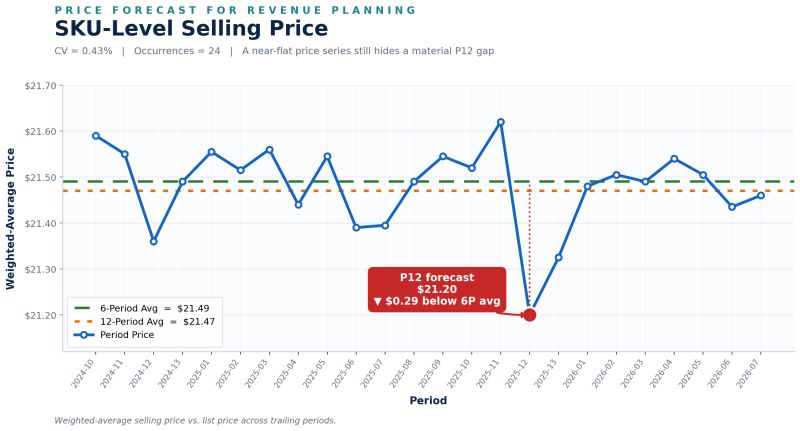
In this example the price series has just a 0.43% coefficient of variation, this SKU's price looks flat enough to just go with an average price for every period.
Then P12 lands at $21.20; and the plan built on the 6-period weighted average ($21.49) over-forecasts revenue by ~$29K on this SKU alone.
- 6-Period Weighted Avg ($21.49) × 100,000 units → $2,149,000
- Actual P12 price ($21.20) × 100,000 units → $2,120,000
- Over-forecast in P12 → ~$29,000
The gap isn't random noise. Price moves with promotional calendars, discount windows, and trade spend and those land in different months for different SKUs.
A promo that hits December on one item hits March on another. Weighted-average pricing smooths all of that into a single flat line: a fine starting point however it hides the seasonal variation.
The result usually isn't lost revenue, it's mis-timed revenue. That timing difference turns a "stable" price into a plan that's right overall but has errors at the monthly level; revenue realization drifting out of phase with what finance expects.
Multiply one SKU's timing gap across a full portfolio and twelve periods, and the phasing error could cause huge variations in the revenue plan used in the IBP process. Even if your volume forecast is 100% accurate, your revenue forecast will be off significantly just due to price forecast errors.
Generally thinking about a price forecasting process that respects promo timing and discount seasonality by SKU and by month pays off in your IBP journey.
When Demand Planners forecast volume and financial analysis forecast revenue as two separate isolated processes, then the IBP process breaks down.
Forecast the volume; and forecast the price. Revenue is just a calculation instead of a separate forecast. Build this into your S&OP process as the IBP step.
Read our related posts:
Leave a Reply